Pune / Thiruvananthapuram
Sitting in the classroom of a Zilla Parishad primary school in a rural village and gazing at the sky, children often wonder about the Moon, stars, rockets and the vastness of space. When classroom learning is complemented by real-world experiences, that curiosity can become the foundation for a future career.
An educational study tour to the Indian Space Research Organisation (ISRO), jointly organised by Pune Zilla Parishad, the Inter-University Centre for Astronomy and Astrophysics (IUCAA), Pune, and Panchayat Samiti, Ambegaon, opened a new horizon for rural students from Thoranale, Chandoli Budruk and Valti.
Following an examination conducted by Pune Zilla Parishad and IUCAA, Rudra Bhausaheb Valunj and Aditya Sanjay Pardeshi from Thoranale, Soham Swapnil Ghule from Chandoli Budruk, and Arnav Pravin Bhor from Valti were selected for the ISRO educational visit. Yagnesh Avinash Minde from Thoranale was selected for an educational visit to the National Defence Academy (NDA), Khadakwasla.
From the Classroom to the Skies
The five-day educational journey began at the Chandrashekhar Auditorium at IUCAA, where students attended a lecture by Madhav Khare on the ‘Science of Flight’. Through demonstrations and explanations, they were introduced to the scientific principles behind aircraft and flight.
The lessons soon moved beyond the classroom. The students travelled by air from Lohegaon Airport to Thiruvananthapuram, giving many of them their very first experience of flying.
Exploring the World of Science
At the Priyadarshini Planetarium and Science Park in Thiruvananthapuram, the students explored planets, stars and galaxies while learning about technologies such as the Hubble Space Telescope, optical fibre and holography. They also witnessed a range of scientific demonstrations and experiments.
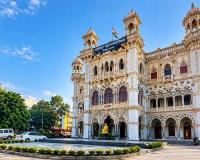
The visit to Martanda Varma Palace and Museum offered the students an opportunity to understand the importance of preserving history and cultural heritage. A visit to Kovalam Beach added a natural dimension to the educational journey.
A Close Encounter with India’s Space Programme
The most significant and inspiring part of the tour was the visit to the Vikram Sarabhai Space Centre (VSSC). Students were introduced to models and information related to landmark Indian space missions and technologies, including Chandrayaan-1, Chandrayaan-2 and Chandrayaan-3, PSLV and GSLV launch vehicles, spacesuits, rockets and robotic technology.
They also visited the Thumba Equatorial Rocket Launching Station (TERLS), where they learned about sounding rockets and technologies used in space research.
Their questions reflected the transformation taking place before their eyes: How does Chandrayaan travel to the Moon? How fast does a rocket travel? How are rockets launched into space?
What began as curiosity was gradually becoming scientific inquiry.
Learning from Scientists
After visiting the Vivekananda Rock Memorial, Thiruvalluvar Statue and Triveni Sangam at Kanyakumari, the students visited the Indian Institute of Space Science and Technology (IIST). There, they learned about educational opportunities in space science, technology and research.
Prasad Khadekar provided guidance on astronomy, while scientist Sarita Vig explained the rotation and revolution of the Sun, Moon and Earth, the phases of the Moon, and the scientific reasons behind day and night.
The students actively participated in the sessions, asking questions and interacting enthusiastically with the scientists.
A Journey That Went Beyond Five Days
The five-day journey eventually brought the students back to Pune. But while the physical journey had ended, their questions, curiosity and dreams had acquired a new direction.
The experience of flying for the first time, visiting science centres and space research facilities, witnessing scientific demonstrations and interacting with scientists helped strengthen their scientific outlook and broaden their understanding of possible career paths.
This was much more than a five-day educational tour. It was a journey from questions to discovery, from curiosity to scientific thinking, and from dreams to goals.
The journey that began in the soil of a village has now turned towards the sky. Perhaps, one of these young students may one day enter the world of space science and research. And when that day comes, they may look back and remember:
“My dreams found their first direction during that ISRO educational tour.”
000