Shenzhen, Agency
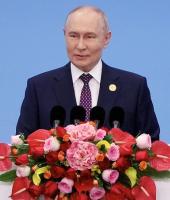
Russian President Vladimir Putin has highlighted Russia's economic performance, expanding trade relations and technological development while addressing business leaders and representatives at the Asia-Pacific Economic Cooperation (APEC) summit in Shenzhen, China.
In his speech, Putin described the Asia-Pacific region as the new centre of global economic activity, stressing its growing influence in international trade, investment and technological innovation.
"It would be no exaggeration to say there has been a tectonic shift, and the Asia-Pacific region is now the centre of the global economy, the main technological hub of the planet," Putin said.
Highlighting the growing importance of the Asia-Pacific region in shaping the global economic landscape, the Russian president said, "The Asia-Pacific region is home to 36 per cent of the world's population, accounts for 50 per cent of global trade and generates 60 per cent of global GDP. "
Addressing economic restrictions imposed on Russia, Putin argued that sanctions, tariffs and export limitations had failed to weaken the country's economy as intended.
Putin targeted the US, saying instead of adapting to the change, "The former hegemons sometimes to their own detriment want to hold back the development of those who demonstrate development and progress. In this situation, countries of the region strive for their own sovereignty on three main levels: state levels, public levels and social and economic levels."
"Sanctions, tariffs and export limitations still have an effect, but they are no longer capable of crushing the economies of competing countries, a failed attempt at holding back our country that has faced unprecedented economic pressure, becoming the record holder in the number of punitive measures imposed on us," he said while mentioning that due to its geographic position, Russia's role in the world economy and politics has passed through these ordeals and "in tightly woven economies, artificial holdbacks and artificial obstacles lead to costs in all other areas."
He also criticised the European Union's economic situation, claiming that restrictions on Russian energy supplies had affected Europe's industrial competitiveness and economic stability.
According to Putin, external economic pressure had encouraged Russia to improve domestic production, increase labour productivity and strengthen its industrial capabilities.
"Over the last three years, Russia's GDP has grown by over 10 per cent and keeps growing," he said.
Putin also cited Russia's unemployment rate of 2.3 per cent and government debt below 17 per cent of GDP as indicators of economic stability.
The Russian president highlighted the growing importance of Asia-Pacific countries in Moscow's international trade strategy.
He said the region's share of Russia's total trade turnover had increased to 53 per cent, compared with just over 25 per cent in 2014.
"We're moving ahead of the plan even. And we're ready to keep that momentum, developing mutually beneficial trade with APEC countries," Putin stated.
He also called for stronger transport and logistics connectivity, including improvements to railway infrastructure, Pacific seaports and cross-border transportation facilities.
Putin specifically highlighted the development of the North Sea Route as an important part of Russia's strategy to expand international trade and transport links.
Putin also emphasised Russia's ambitions in artificial intelligence, digital services, financial technology and advanced manufacturing.
He said Russian technology companies were developing large language models, digital platforms and online services that could be expanded into international markets.
"Digital platforms and artificial intelligence, without exaggeration, are making a revolution in Russia's education, healthcare, science and state governance," he said.
He added that Moscow was prepared to share its technological expertise with international partners while supporting their technological independence and protecting sensitive data.
The president also highlighted investment opportunities in Russia's Far East and Arctic regions, announcing plans for a new preferential investment framework scheduled to begin on January 1, 2027.
The proposed framework is intended to encourage investment, industrial development and the testing of emerging technologies, including robotics, artificial intelligence and drones.
Putin invited APEC member economies to explore investment opportunities in these regions.
Discussing international economic cooperation, Putin highlighted Russia's efforts to expand trade agreements through the Eurasian Economic Union.
He referred to ongoing negotiations with several countries, including India, Tunisia, Syria, Pakistan, Jordan, Egypt, South Africa and Zimbabwe.
He also described closer economic cooperation with China as an important component of Russia's broader Eurasian integration strategy.
"Instead of being separated, it is extremely important to be united; to be equal, not hegemons; partnership, not isolation; and dialogue instead of ultimatums," Putin said.
Concluding his address, Putin called for greater cooperation among APEC economies amid growing geopolitical tensions and fragmentation in the global economy.
He also expressed expectations for a proposed trilateral meeting involving the leaders of Russia, China and the United States on the sidelines of the summit.
Putin thanked China for hosting the event and wished Vietnam success as the next chair of APEC.
He further confirmed Russia's interest in hosting the APEC summit in 2035.
"We are looking forward to welcoming you all in Russia at the St. Petersburg Economic Forum and in Vladivostok, the Far Eastern Economic Forum, next year," Putin said.
He concluded by reaffirming Russia's commitment to expanding economic cooperation and strengthening partnerships across the Asia-Pacific region.
000