In Goa, local Electoral Registration Officers heard 97 voters, examined their documents and found them eligible for the final electoral roll. Yet the software offered no way to record that decision. The state election office wrote to the Election Commission eight times in seven days asking for a rollback facility. The deadline arrived; the facility had not. The 97 names stayed out.
That account, reported by The Indian Express, gives the Election Commission of India’s September 26 press note its human measure. The Commission says 81 of the 97 voters have since filed Form 6 and that the state Chief Electoral Officer has been asked to facilitate their inclusion. The assistance matters. So do the questions that remain: why did voters already found eligible need to apply again, what happened to the requested software change, and has a reliable route been provided for everyone affected?
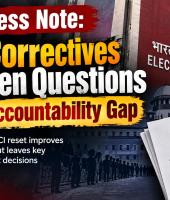
The note announces nine decisions after a full Commission meeting. Several address, almost item for item, concerns recorded by Election Commissioners Sukhbir Singh Sandhu and Vivek Joshi. But a system can announce better rules for tomorrow without accounting for how it worked yesterday. That is the distinction at the heart of the current dispute.
A reset is not a retrospective account
Ritika Chopra’s Indian Express investigation reported that Sandhu and Joshi had put objections on record at least 14 times over ten months, including four objections on one day. The questions touched the Commission’s core work: who could enter or remove names from the rolls, who could restore them, who controlled the software, and who authorised appeals against decisions on voters. The Commission’s initial public response described the notes as suggestions or inputs and said important SIR decisions had unanimous approval.
The September 26 note moves beyond that first response. It provides for agendas before Commission meetings and minutes afterwards; Commission approval for officials’ foreign travel; an officers’ committee to review new IT modules before they go to the full Commission; and an ECINet review led by a senior Deputy Election Commissioner with an independent IIT or IIIT expert. It promises added flexibility for field officials who need it and says Commissioners’ directions must be meticulously followed. These are substantive measures. They could improve collective oversight and make field decisions easier to carry out.
A blanket description of the note as a non-response would therefore miss what it does. But describing it as a point-by-point answer would miss what it does not. The new procedures do not disclose who approved disputed communications, whether contested software changes had authority, what happened to objections when they reached the Commission, or whether any officer was held responsible. The note’s strongest content is prospective. The investigation’s hardest questions are retrospective.
The objections were about power inside the process
The chronology matters because the objections were repeated, not confined to one disputed form. In October 2025 and again in April 2026, Sandhu and Joshi questioned whether letters and orders were being issued in the Commission’s name without approval of the Commission. On April 16, objections also addressed meetings without advance agendas, incomplete records and foreign visits by officials. Joshi again raised the communications issue on April 24. New rules on agendas, minutes and travel directly meet those procedural concerns.
What remains missing is a record of the earlier decisions. Which communications were challenged? Who approved them? Were they later ratified, corrected or withdrawn? Which trips were undertaken without Commission approval, and under whose authority? A public register of approvals and corrections would answer these questions more clearly than a general assurance that procedures will improve.
The July work-allocation dispute shows why such detail matters. Joshi approached the Cabinet Secretary after an officer allegedly redistributed work without the Commission’s knowledge; Sandhu separately objected and sought action. The press note offers a partial clarification: it says the redistribution was never implemented and that Deputy Election Commissioner-level oversight of IT was not withdrawn. That settles an important question about the order’s practical effect. It does not identify why the order was issued without the Commissioners’ knowledge, whether the process was reviewed, or what action, if any, followed. The later cancellation of an order explains its end, not its origin.
Form 6 is more than a box on a screen
The dispute over Form 6 is narrower than the debate over the SIR itself, and that is precisely why it needs a precise answer. In May, Joshi objected that the prescribed Form 6 could not be changed without amending the rules; Sandhu agreed. In July, the online version on ECINet added a question asking whether an applicant, or a parent or grandparent, appeared on the last SIR roll. Applicants could not submit the online form without answering it. On August 13, Sandhu described the alteration as “unauthorised and illegal” and sought its removal.
The September note says the statutory form will apply outside the SIR period and invokes the Supreme Court’s May 27 judgment. But the outstanding question concerns the online form and the authority for inserting the additional field. The note does not say whether the field has been removed, who added it, or under which legal instrument. Saying that a prescribed form will apply outside the SIR period does not tell a would-be voter what the portal requires during the SIR, or whether that requirement was made through the process the law demands.
The Supreme Court’s ruling upheld the Commission’s authority to conduct the Bihar SIR and its broad framework. That is significant. It does not automatically resolve every later administrative choice made in implementing a revision. The Indian Express’s September 27 analysis noted that the judgment does not appear to uphold the disputed online declaration in express terms. The distinction is basic: approval of an exercise is not necessarily approval of each subsequent software field, access rule or communication connected to it.
The voter roll now has a software chain of command
A voter list is a legal record maintained through public authority. Software can make that record easier to manage, but it cannot quietly become the authority that decides which lawful officer may act. Joshi’s May 29 objection warned of a “gradual centralisation” of the electoral-roll database and called for an audit of who held credentials to change it. Sandhu’s August 14 note questioned whether field officials had full access to ECINet and whether the Director General of IT could restrict the work of statutory officers.
The Commission now says access is role-based, promises added flexibility where required and has ordered an expert-assisted ECINet review. Those steps respond to the concern. Yet an announced review is not an audit result. The public still needs to know what access existed during the disputed period, who assigned it, whether any statutory officer was blocked from acting, and what the system logs show. An independent review should publish its terms, findings and corrective actions, subject to safeguards for personal data and system security.
The same issue sits behind the work-allocation objections. In late July, both Commissioners challenged an administrative order affecting oversight of the IT division and cancelled it. The Commission’s statement that no oversight was actually withdrawn narrows the dispute; it does not eliminate it. When authority over the machinery of the rolls is contested inside the body charged with protecting them, a public account of the chain of command is necessary.
Bengal is the unanswered question with the widest reach
The sharpest silence concerns West Bengal. According to The Indian Express’s report on the Commission’s submission to the Supreme Court, 16.10 lakh appeals had been filed against voters whom judicial officers had included during the SIR adjudication. The Commission’s reply did not identify who filed those appeals. In an August 12 note, Sandhu asked who had authorised appeals against voters whom judicial officers had directed to include, and who had filed them in the Commission’s name.
That question is not answered by saying the main SIR orders were unanimous. Nor does the number alone prove that the appeals were improper, reveal who initiated them, or show that they changed an election result. The point is more exact: an appeal against an individual voter’s inclusion exercises public power. The public should be able to see the authorised decision, the legal basis, the officer responsible and the case-specific grounds. Where that trail is absent, suspicion fills the space that records should occupy.
The distinction matters politically because electoral-roll decisions determine who is eligible to vote before campaign arguments reach the ballot box. But a political dispute is not proof of fraud. The evidence cited here does not establish that the Commission manipulated outcomes. It establishes that two Commissioners repeatedly questioned authorisation and control, that a software failure left 97 Goa voters off a final roll despite local eligibility findings, and that the authorship of a large set of Bengal appeals was not specified in the reported court filing. Those facts warrant scrutiny on their own terms.
What the law settles and what it leaves open
The Election Commission is a constitutional body under Article 324. Section 18 of the 2023 law governing the Chief Election Commissioner and Election Commissioners says Commission business should, as far as possible, be transacted unanimously; if the Commissioners differ, the majority decides. The section also says the Commission must settle its procedure and division of work by unanimous decision. This does not mean that every objection by two Commissioners invalidates a decision. It does mean that a serious disagreement about procedure or work allocation should have a traceable resolution.
The Commission’s statement that SIR orders were approved unanimously may be true and relevant. It can coexist with objections to particular acts taken during implementation. A full Commission might agree to conduct a revision while members later dispute who changed a form, who controlled access, whether a communication had approval, or who filed an appeal. Treating these as the same question turns a useful defence into a diversion. They are different decisions, made at different points, and each has its own record.
Nor is the question whether the ECI had authority to revise rolls identical to whether every operational step complied with law, procedure and the Commission’s own allocation of responsibility. The Supreme Court’s ruling on the broad SIR framework cannot supply missing internal approvals or explain a software setting adopted afterwards. A judicial judgment and an administrative audit answer different questions.
Public confidence needs a paper trail
The timing of the press note invites a political interpretation: perhaps the Commission wanted to calm public anger after the investigation became public. The available record does not establish motive, and it should not be presented as fact. The evidence supports a narrower criticism that is harder to dismiss: after an investigation disclosed repeated internal objections, the Commission announced safeguards that closely correspond to several concerns but left key disputes about past decisions without a public, point-specific explanation.
The route to restoring confidence is practical. The Commission can publish an action-taken statement against each of the 14 objections; identify which communications and software changes were approved, by whom and under what authority; explain the Form 6 requirement and its current status; publish the ECINet review’s remit and conclusions; disclose the authorisation and grounds for the Bengal appeals; and report how all 97 Goa voters can secure the inclusion already found proper by local officers. These disclosures should protect personal data without concealing institutional decision-making.
The September 26 note may be the beginning of a necessary reset. Its safeguards matter. But a promise to follow rules from now on cannot tell voters whether the rules were followed before. For that, the Election Commission must show the trail: who decided, who approved, who could act on the roll, and how a citizen is made whole when the system fails. In an election, trust is built before a vote is cast. It depends on a roll that is accurate, an authority that can be questioned, and an answer that is more than a new procedure.
000