PUNE, Staff Reporter
“In an era where artificial intelligence tools can generate instant answers. AI applications like ChatGPT can provide answers to questions within seconds, making it essential for students to move beyond mere recall and master the ability to think better than AI to solve problems. Only those with the capability to outperform AI will be able to sustain their careers and employment in the future,” said Prof. Sunil Bhagwat, Director of the Indian Institute of Science Education and Research (IISER) Pune. Prof. Bhagwat was delivering the valedictory address for the higher education track at the 4th Regional Research Symposium on Problem-Based Learning (RRSPBL 2026) on Saturday. Organized by MIT Vishwaprayag University Solapur at the IISER Pune campus, the three-day international conference brought together global academicians, policymakers and industry leaders to strengthen synergy across school education, higher education and industry.
Addressing educators and researchers, Prof. Bhagwat cautioned against reducing education to passive information gathering and rote memorization. He highlighting that “project-based learning is not a new concept but is rooted in the original purpose of formal education solving societal needs Prof. Bhagwat urged institutions to overhaul their academic frameworks. He observed that over time, the education system drifted away from its core objective and stressed the need to redesign curricula starting at the undergraduate level.”
Presiding over the symposium, Prof. Swati Karad Chate, Executive President of MIT Vishwaprayag University, emphasized that experiential learning must become the backbone of both schools and universities. She remarked that “project and problem-based learning is an integral part of human life and the time has come to embed it systematically into the education system, particularly at the school level. In rapidly changing times, higher education must pivot decisively toward research, innovation and hands-on experiential learning so that students go beyond textbook knowledge to understand societal and industrial challenges and engineer practical solutions,” she added.
Earlier, speaking as the Chief Guest at the valedictory session for the school education track, Dr. Arvind Natu, Chairperson of the Board of Governors IISERs, called for urgent reforms in classroom culture and student assessment. Explaining that project and problem-based learning progresses through four key stages; asking questions, searching for information, ideating, and developing solutions. Dr. Natu pointed out that students in the current system stumble at the very first stage of asking questions. He stressed that curiosity must be nurtured from a young age by eliminating the fear of examinations and introducing evaluation methods that assess what students know rather than what they do not, noting that education becomes truly meaningful only when learners see how classroom concepts connect to real life.
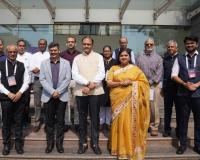
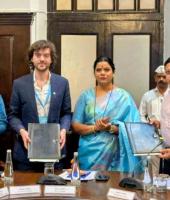
The symposium aimed to increase the community of educators practicing problem-based learning. Over the course of three days, facilitate the exchange of global best practices through research paper presentations, parallel hands-on workshops and keynote addresses. Eminent national and international dignitaries who participated and shared insights across sessions on school-university synergy, academia-industry collaboration; research, innovation and entrepreneurship. Vice-Chancellor of MIT Vishwaprayaag University Prof. Gopalkrishna Joshi, UNESCO PBL Centre Director at Aalborg University (Denmark) Prof. Xiangyun Du, Executive Director of IUCEE Prof. Krishna Vedula, Pro VC & President of Curtin University (Singapore) Prof. Alex Stojcevski, Vice-Chancellor of Dr. D. Y. Patil University (Navi Mumbai) Dr. Arun Patil, Founder of Sankalp Semiconductor Vivek Pawar and Vice President of Kalasalingam Academy of Research and Education (Tamil Nadu) Dr. S. Shasi Anand was present during the occasion.
During the closing ceremony, Prof. Alex Stojcevski officially announced that the 11th International Research Symposium will be hosted in Singapore in November 2027. Prof. Dr. Gopalkrishna Joshi emphasised the importance of research experimentation, measurement of outcomes, systematic documentation, and publication of research papers.
The valedictory proceedings opened with a welcome address by Dr. Prabha Kasliwal, followed by a comprehensive review of the three-day deliberations by Dr. Preeti Baligar and concluded with a vote of thanks proposed by Prof. Gopalkrishna Joshi.
000