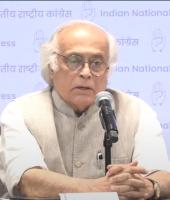
New Delhi, Agency
Congress leader Jairam Ramesh on Wednesday recalled Dr B R Ambedkar's landmark November 25, 1949, speech in the Constituent Assembly, describing it as an immortal contribution to India's democratic thought and underlining the enduring relevance of his warnings against dictatorship, political hero-worship and social and economic inequality.
In a post on social media platform X, Ramesh said that 77 years ago, Ambedkar delivered one of the most iconic, influential and immortal speeches of 20th-century India while moving the Draft Constitution for adoption in the Constituent Assembly. The Constitution was adopted on November 26, 1949, and came into force on January 26, 1950.
Revisiting the historic address, Ramesh reproduced five significant passages that captured Ambedkar's reflections on the Congress Party's contribution to constitution-making, the importance of constitutional methods, the dangers of personality cults and the need to establish social democracy on the principles of liberty, equality and fraternity. Recalling Ambedkar's acknowledgement of the Congress Party's role in the Constituent Assembly, Ramesh highlighted his observation that the party's presence had virtually eliminated the possibility of chaos and brought order and discipline to the proceedings. Ambedkar had said that the Congress Party was "entitled to all the credit for the smooth sailing of the Draft Constitution in the Assembly."
Ramesh also drew attention to Ambedkar's prescient warning that democracy could retain its outward appearance while being undermined from within. "It is quite possible for this new born democracy to retain its form but give place to dictatorship in fact," Ambedkar had cautioned, stressing that constitutional methods must remain the means of achieving social and economic objectives if democratic institutions were to survive in substance. Perhaps the most striking passage concerned the dangers of hero-worship in politics, a warning that continues to resonate in India's political discourse. Ambedkar had drawn a sharp distinction between religious devotion and political allegiance, declaring, "Bhakti in religion may be a road to salvation of the soul. But in politics, Bhakti or hero-worship is a sure road to degradation and to eventual dictatorship." Another central theme of the speech was the inseparable relationship between political and social democracy. Ambedkar argued that political democracy could not endure without social democracy, which he defined as a way of life recognising liberty, equality and fraternity as its fundamental principles. He described the three as an inseparable trinity, warning that treating them as independent of one another would undermine the foundations of democracy.
Ramesh also recalled Ambedkar's profound warning that India was about to enter a life of contradictions with the commencement of the Constitution. While political democracy would guarantee the principle of one person, one vote and one vote, one value, the country's deeply entrenched social and economic inequalities would continue to deny citizens equality in their everyday lives. "How long shall we continue to live this life of contradictions?" Ambedkar had asked, urging the nation to eliminate these contradictions at the earliest possible moment. Delivered at a defining juncture in India's transition from colonial rule to constitutional self-government, the address was much more than an assessment of the proposed Constitution. As chairman of the Constituent Assembly's Drafting Committee, Ambedkar used the occasion to caution the country against the political and social forces that could weaken its democratic foundations. His message was that democracy could not be sustained merely through elections, constitutional provisions and institutional arrangements. It required adherence to constitutional procedures, democratic conduct, social justice and an unwavering commitment to equality. His warning against the concentration of political authority and the elevation of individuals above institutions was equally central to his vision of a functioning democracy.
Describing the address as a "magnificent speech", Ramesh said it was "for the ages" and "ever relevant", emphasising that Ambedkar's words continued to offer a compelling reminder of the values, responsibilities and safeguards essential to preserving India's constitutional democracy.
000