- Op-Ed
- Safety First: Why Arunachal Must Reconsider Its Development Model
Safety First: Why Arunachal Must Reconsider Its Development Model
From mega-dams and cut slopes to a resilient economy of rivers, forests and indigenous enterprise

By Prof Ujjwal K. Chowdhury
THE PROPOSITION
Arunachal Pradesh does not have to choose between poverty and peril. It has to choose whether its rivers, forests and cultures will be treated primarily as national inputs, or as the living capital of a safer, higher-value local economy. The glacier-and-rock collapse reported in Nepal, the warning from Sikkim and Arunachal's own contested hydropower trajectory make that choice urgent.
The Himalayas do not announce a disaster only when a dam breaks. They announce it through a spring that disappears after a tunnel is drilled, a road that slips every monsoon, a river whose sediment no longer reaches downstream fields, a village whose consent is counted only after the map is final. Arunachal Pradesh is at the point where these signals have to become policy.
The mountain is not an empty balance sheet
The most important fact about Arunachal Pradesh is also the fact most development plans suppress: it is a young mountain system still being made. Steep slopes, fractured rock, intense monsoon rainfall, active faults, fragile soils and a changing cryosphere respond to every road cut, tunnel, quarry, reservoir, settlement and drainage alteration.
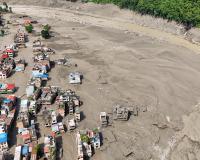
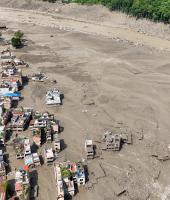
The three Counterview articles place this reality beside the August 26, 2026 glacier-and-rock collapse reported along the Nepal-Tibet border. A high-mountain failure became a debris flow, flood, infrastructure destroyer and humanitarian crisis downstream. The trigger was geological and cryospheric; the scale of loss was shaped by what had been built in the path of risk. Climate change changed the structure of risk by weakening ice, destabilising slopes, altering rainfall and making old design assumptions unreliable.
Arunachal shares the conditions that make the Nepal event a warning: high seismicity, steep river valleys, expanding glacial lakes, cloudbursts, landslides and difficult emergency access. It has also experienced its own cloudbursts, road failures and district isolations. A road celebrated at inauguration but not maintained through the monsoon is not durable connectivity. A dam that multiplies a debris surge is not automatically a resilience asset.
The question, therefore, cannot remain: how quickly can Arunachal add megawatts, kilometres of road and concrete? It must become: developed for whom, with what exposure, and at what price to the families who will live on these slopes fifty years from now?
When infrastructure becomes exposure
For two decades, Arunachal's development story has been narrowed into a familiar template: large hydropower projects for the national grid, strategic roads across unstable terrain, tunnelling through mountains and the rapid conversion of rivers into infrastructure corridors. The needs are genuine - roads, hospitals, schools, communications, jobs, energy and border security. But genuine needs do not make every engineering response wise.
Upper Siang and Etalin are the clearest tests of that wisdom. The proposed Siang Upper Multipurpose Project, often described as an approximately 11,000 MW project, and the 3,097 MW Etalin project in the Dibang basin sit in landscapes that are seismically active, biodiverse and socially sensitive. Their proponents may present national power, flood moderation or strategic value; critics see high-consequence exposure in valleys where evacuation, rescue and compensation would be extraordinarily difficult.
Project-by-project clearance is not enough when the river basin is the real unit of impact. A dam, access road, transmission corridor, tunnel, quarry and downstream cascade operate as one system. Blasting disturbs slopes and springs; hill-cutting changes drainage; a landslide can block a river, send an impulse wave into a reservoir or sever a village road. A GLOF or debris flow can breach a large structure and magnify the downstream disaster. Tofu-dreg infrastructure - built too quickly or cheaply for its setting - is a governance warning.
The ecological bill is equally serious. Reservoirs submerge forests, fragment habitat, trap sediment and alter fisheries, riverine agriculture and downstream geomorphology. High-head barriers obstruct migratory fish; decaying biomass can release greenhouse gases. A centralised plant is also a single point of failure: if its powerhouse, transmission line or bridge is cut, the distant grid and the local community may lose power together.
Sikkim offers a caution that Arunachal should not dismiss. The third Counterview article notes that the National Remote Sensing Centre assessed a 42 per cent probability of a South Lhonak Lake breach in 2013. On October 3-4, 2023, the lake breached; the Teesta III dam at Chungthang was destroyed, 55 people died, 74 went missing, more than 7,000 people from 1,756 families lost their homes, and thousands of houses were damaged across Sikkim. The reported proposal to rebuild at the same location, with a structure almost twice as high, illustrates the danger of treating a known risk as a reason for taller concrete rather than better land-use decisions.
The missing people in the numbers
The Upper Siang debate reveals why displacement cannot be reduced to a compensation spreadsheet. Project-side accounts cited in the dossier speak of around 16 villages and roughly 10,000 people directly affected. Community organisations and researchers speak of at least 27 villages, a 40-300 village impact zone and more than 150,000 people, depending on whether farmland, forest access, fisheries, grazing, sacred sites and downstream livelihoods count. The disagreement asks who is visible to the state.
For the Adi people, the Siang is not an empty channel with a calculable flow. Ane Siang, the Mother Siang, is a cultural and ecological relationship. A village contains homes, terraces, orchards, fishing grounds, mithun routes, burial places, ritual spaces, memories and kinship networks. A resettlement colony can reproduce houses, not a river's meaning or the social geography through which knowledge travels. Compensation cannot restore a place-based civilisation.
Etalin presents a smaller numerical footprint with the same principle. Project documents cited in the dossier indicate about 265 families in eight affected villages, with around 95 families facing involuntary displacement, while the project requires diversion of roughly 1,175 hectares of forest land. The project's environmental clearance has also faced legal challenge. Whether one supports or opposes the project, the lesson is clear: the burden of proof must rise when the cost is irreversible.
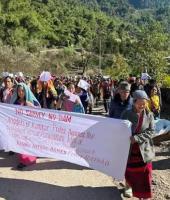
Indigenous resistance to Upper Siang and Etalin is not an obstacle that publicity can remove. Adi institutions, farmers' forums, youth groups and human-rights advocates question consent, cultural survival, safety and benefit-sharing. Some affected families and village groups support the projects for expected flood protection or economic opportunity. That diversity makes independent deliberation essential. A signature after the design is fixed is not free, prior and informed consent.
WHAT THE UPPER SIANG NUMBERS REVEAL
Official or project-side accounts cited in the dossier: about 16 villages and roughly 10,000 people directly affected. Community and civil-society accounts: at least 27 villages, a wider 40-300 village impact zone and more than 150,000 people. The gap is not a licence to choose the largest figure; it is evidence that the definition of 'affected' must include land, forests, rivers, culture and downstream livelihoods.
A moratorium is a responsibility, not a rejection of development
Arunachal should declare a time-bound moratorium on new large storage dams and high-risk cascades in the most vulnerable basins. This would create space for independent, cumulative assessments that model earthquakes, GLOFs, landslide impulse waves, sediment, extreme rainfall, upstream operations and failure of roads and communications together.
The state needs a public hazard atlas. No-go zones should cover the highest landslide and GLOF susceptibility areas, irreplaceable biodiversity corridors and sites where evacuation is implausible. Low-no zones should permit only light, reversible or strictly conditioned activity. Settlements and critical assets already at risk need voluntary relocation or retrofitting, with land, services, transport and livelihoods planned together.
Early warning is a social system, not a dashboard. Satellite and AI tools, weather radar, rain gauges, glacial-lake sensors, river gauges and slope monitors matter only if a village receives a clear alert, knows the safe route and practises the drill. Data-sharing across the India-Bhutan-China-Nepal Himalayan arc should be pursued wherever diplomacy allows.
Roads and bridges should follow mountain behaviour: drainage first, slope bioengineering, vegetation reinforcement, controlled spoil disposal, spring protection, geotechnical inspection and dedicated maintenance. Vetiver, alder, bamboo and hydroseeding should complement engineering. The most strategic road may be the one that remains open and repairable, not the widest on inauguration day.
Quality of life is the unit of progress
A safer development model must answer everyday questions: can a child study during a monsoon outage, can a pregnant woman reach care, can a farmer sell without distress, can an elder remain in a familiar community, can a young person earn without leaving, and can a family sleep without fearing the next slope failure? These are the real measures of resilience.
- A safe home is infrastructure: Retrofit vulnerable homes and support voluntary, culturally appropriate relocation from the highest-risk zones. Promote earthquake-resilient construction using bamboo, cane, timber and local design knowledge wherever technically suitable.
- A reachable service is development: Combine district hospitals with telemedicine, mobile health units, emergency transport protocols and digital classrooms, so people need not be concentrated in unsafe places simply to reach a service.
- A maintained road is better than a grand road: Use geotechnical routing, drainage, bioengineering and slope monitoring. Limit widening, protect springs and accept seasonal or low-capacity routes where necessary. Budget maintenance as a core asset, not a post-disaster appeal.
- Local energy is strategic energy: Combine safe micro-hydro, rooftop solar, storage and islandable microgrids so border villages, schools, clinics, communication nodes and emergency centres remain powered when landslides cut the main line.
Tourism that pays the village
The alternative to mega-project dependence is an economy that earns more from each unit of landscape without consuming it. Tourism can be a pillar, but Arunachal should avoid the familiar sequence in which roads arrive, hotels multiply, waste and water stress follow, and the host community receives the least value.
Build high-value, low-density tourism around certified homestay clusters and community lodges regulated by village institutions or Kebangs. Publish carrying-capacity studies before scaling visitors, and use permits, seasonal quotas and route zoning for high-altitude lakes, glacial passes, sacred sites and wildlife corridors. Access must fit slope stability, water availability, cultural dignity and emergency capacity.
The product should be experiential: Eaglenest birding, alpine botany, high-altitude treks, monastery and living-heritage circuits in Tawang and West Kameng, cultural and culinary immersion, river interpretation, farm stays, harvests and festivals. Tawang, Ziro, Mechuka, Namdapha and Pasighat can develop distinct identities. Kaimoi's Best Tourism Village recognition and work in Namsai show that cultural revival can be an economic asset.
Room revenue, guide fees, permits, conservation fees and craft sales should flow to village committees and households. Cooks, drivers, porters, performers, farmers and artisans should be named beneficiaries. Training should cover hospitality, first aid, rescue, waste, digital booking, language and storytelling. Homestays need water, sanitation, fire, waste and structural standards without being forced to imitate urban hotels.
The Lower Subansiri pondage proposal - a controlled tourism, adventure, cultural and inland-fisheries hub - deserves a transparent feasibility test. Reusing an altered site may be preferable to opening new upstream valleys, if safety, carrying capacity, fish ecology and community ownership are secured. Tourism must be a conservation contract: visitors receive meaning, communities receive income and ecosystems receive limits.
Agriculture must leave as a product, not a truckload
Agriculture should not leave Arunachal only as a truckload of unprocessed produce. Its microclimates can support a premium basket of kiwi, mandarin oranges, pineapple, apples, persimmon, walnuts, large cardamom, ginger, turmeric, chillies, buckthorn, medicinal plants, millets, Khamti rice, yak churpi and distinctive beverages. APEDA's buyer-seller work at Tawang points toward FPOs, FPCs, women's Self-Help Groups, branding, exports and value addition. The missing layer is a distributed system that lets farmers retain more value.
Each producing cluster should have small solar-powered processing and packing capacity: grading, pulping, juicing, drying, pickling, fermentation, spice processing, safe packaging and traceability. Five- to ten-tonne community cold rooms can prevent distress sales when landslides block roads. A brand such as Arunachal Organic Himalaya can sit above district and tribal brands only if certification, quality control and producer ownership are real. Geographical indications should protect and premiumise distinctive products, not merely decorate packaging.
Farmer Producer Companies should negotiate directly with urban retailers, hotels, institutions and exporters. Digital catalogues can show harvest windows, volumes and quality; public procurement can place local produce in schools, hospitals and tourism kitchens. Finance must cover working capital, cold chains and packaging. Women-led processing, food entrepreneurship and local logistics can create jobs without forcing young people to leave.
Climate-smart agriculture should strengthen, not erase, local knowledge. Jhum should not be eliminated by decree; improved fallows, contour planting, water harvesting, agroforestry and community fire management can reduce erosion while preserving food cultures. Nitrogen-fixing alder, Alnus nepalensis, can be integrated with heirloom tea and black pepper. Success is a productive hillside that keeps soil, water, biodiversity and income together.
Healing landscapes, not resort landscapes
Arunachal's forests, clean air, hot springs, highland climates and spiritual traditions can support a careful nature-wellness economy. This is not a licence for large resorts. It is an invitation to design small, regulated experiences: forest-bathing or Shinrin-yoku trails, meditation retreats, monastery stays, nature-therapy walks, restorative food and hot-spring facilities with strict water and waste limits.
Guides should be trained in ecology, mental-health first response, visitor safety and the limits of therapeutic claims. Indigenous dietary, herbal and healing knowledge must be documented with consent and benefit-sharing. Cooperative processing of managed non-timber products such as Mishmi teeta, wild turmeric or Taxus-related resources must prevent overharvesting and bio-piracy. Wellness should complement, never replace, public healthcare.
Craft and local design as a living economy
The cultural economy should be a productive sector, not an annual festival display. Apatani, Adi, Nyishi, Monpa and other weaving traditions; bamboo, cane and beadwork; Monpa paper; thangka and Buddhist art; and Wancho wood carving carry design intelligence. The challenge is repeatable income without flattening distinct identities into one generic Northeast aesthetic.
District craft and design hubs can provide shared tools, natural-dye research, photography, packaging, e-commerce, accounting and market access. Partnerships with design institutes, fashion labels, architects and responsible retailers must protect attribution, intellectual property, fair prices and artisan control. A digital maker passport can connect each product to its maker, village, technique and material story; tourism circuits can add demonstrations, workshops and direct sales.
Bamboo and cane bridge heritage with climate resilience. Bamboo anchors soil and can support homeware, furniture, structural alternatives and earthquake-conscious vernacular housing when engineered properly. Documentation and apprenticeships are vital: if craft is poorly paid, the state loses both a livelihood and an irreplaceable knowledge archive.
A VILLAGE POWER TEMPLATE
Illustrative 500 kW community-owned run-of-the-river model: 800-1,200 households and local institutions served; about Rs 4.5-5.5 crore capital cost; roughly 2.6 million kWh annually at 60 per cent capacity factor; customary council as trustee; Village Energy Management Society with women and youth representation; 35 per cent of revenue for O&M, 25 per cent for debt and 40 per cent for capital reserve, social dividend and watershed protection. Final feasibility, tariff and safety decisions must remain site-specific.
Power where people live
Arunachal's energy security does not require every river to become a gigawatt corridor. Safe run-of-the-river micro-hydro units, generally 10 kW to 2 MW, combined with solar and storage, can provide power close to where people live. Lower head, negligible storage and small civil footprints can reduce the scale of failure compared with a large reservoir, while allowing community ownership. No micro-hydro site is automatically safe; every site needs hydrology and geotechnical review.
An illustrative 500 kW community-owned project could serve 800 to 1,200 households, schools, clinics and micro-enterprises. The dossier models a capital cost of Rs 4.5-5.5 crore and, at a 60 per cent capacity factor, around 2.6 million kWh a year. A customary council - Kebang, Tsumok or equivalent - can hold the land and water-use trust. A Village Energy Management Society can run the plant, with elders, a technical representative, local youth technicians and at least 50 per cent women and youth representation.
Local operators should flush abrasive silt traps during the monsoon; four village youths can become primary and apprentice 'barefoot engineers'; the turbine maker can provide an annual maintenance contract; and prepaid smart metering can remove billing friction. A workable financing stack could blend 60 per cent public subsidy, 20 per cent CSR or green-climate finance, 15 per cent concessional debt and 5 per cent community land and labour.
Tariffs can protect dignity and reliability: a lifeline domestic rate, a higher commercial rate for homestays and processing, and a regulated feed-in price for surplus. The illustrative revenue waterfall allocates 35 per cent to O&M, 25 per cent to debt service and 40 per cent to resilience - 15 per cent capital reserve, 15 per cent village social dividend and 10 per cent catchment protection. Energy then runs dryers, kiwi sorting lines, grain mills, five- to ten-tonne cold rooms and local EV charging hubs.
The ten decisions that can change Arunachal's trajectory
The state government can turn the argument into a social contract through ten decisions over the next 24 months. The sequence matters: first reduce irreversible exposure, then build the institutions and markets that make safer livelihoods credible.
- Pause new large storage dams and high-risk cascades while independent basin studies examine seismicity, GLOFs, landslides, sediment, climate projections and dam-break cascades.
- Create a public hazard atlas with no-go and low-no zones for heavy infrastructure, biodiversity corridors and high-risk settlements.
- Install real-time glacier, lake, rainfall, river and slope sensors in districts including Tawang, Dibang Valley and Anjaw, linked to village sirens, drills and last-mile communication.
- Make cumulative impact assessment and public disclosure mandatory for roads, tunnels, quarries, transmission lines and hydropower.
- Create a permanent Mountain Maintenance and Resilience Fund for drainage, bioengineering, bridge inspection, road restoration, emergency stocks and local responders.
- Launch district missions for community tourism, organic value chains, craft, design and nature wellness, with low-interest finance, procurement and ecological standards.
- Give FPOs, FPCs, women's SHGs, artisan guilds and tourism committees direct access to markets, digital systems, training and working capital.
- Adopt an enforceable FPIC-like protocol: disclose alternatives, recognise customary institutions, record dissent and share risks and benefits before decisions are final.
- Build decentralised energy around safe micro-hydro, solar, storage and islandable microgrids, with community, women and youth governance.
- Measure progress through disaster losses, forest cover, water quality, green-sector income, youth retention, service access and community satisfaction alongside GDP and capacity.
A future measured in more life per unit of concrete
Arunachal does not face a binary choice between dams and poverty. It faces two theories of development. One treats the state as a resource warehouse whose rivers are exported, slopes cut faster than they heal and people compensated after decisions. The other treats mountains as the foundation of a local economy: forests that protect water, rivers that sustain culture and fisheries, farms that earn through processing, villages that host visitors on their terms, crafts that carry identity and energy systems that keep communities resilient.
National security is not weakened by this second theory. A village with safe housing, a clinic, a digital classroom, a community microgrid, trained responders, maintained roads and dignified livelihoods is stronger than a landscape tied to one vulnerable transmission corridor. Ecological protection and strategic presence can reinforce each other when people are custodians and partners.
The Nepal disaster, the Sikkim precedent and Arunachal's monsoon failures are not prophecies. They are choices made visible in advance. The government can still pause, listen, map, maintain and diversify. The goal is more safety, income, health, culture and possibility with less ecological damage. In a fragile Himalaya, that is the only progress that can endure.
00000
Sources and editorial note
Wangchuk Tsering. Safety first: Why reconsider hydropower in fragile Arunachal. Read online
Neha Desai. Why the Nepal disaster is a warning Arunachal Pradesh cannot ignore. Read online
Raj Kumar Sinha. Rising climate risks demand a new Himalayan development model. Read online
APEDA / Press Information Bureau. APEDA and Government of Arunachal Pradesh host International Conclave cum Buyer-Seller Meet at Tawang. Read online
APEDA. Arunachal Pradesh: GI and agricultural products profile. Read online
Shiv Nadar University, Centre of Excellence for Himalayan Studies. Dams in the discourse of development: vulnerabilities and systematic barriers to communities-inclusive policies in Arunachal. Read online
About The Author

Ujjwal K. Chowdhury is a senior academic, institution-builder, and political analyst based out of Kolkata, India.


Latest News
ePaper
Advertisement