- Op-Ed
- Indian Democracy on Trial: The Footsteps of an Undeclared Emergency
Indian Democracy on Trial: The Footsteps of an Undeclared Emergency
From the tear gas and barricades of the July 20 “Sansad Chalo” march to the threatened forests of Great Nicobar, India’s citizens are increasingly being treated not as participants in democracy, but as problems to be controlled.

Prof Ujjwal K Chowdhury
India’s democracy is not currently facing a formally proclaimed Emergency. The Constitution has not been suspended, elections continue to be held, courts remain open and Parliament continues to meet. Yet, across the country, something ominous is becoming visible.
Students asking why examination papers are repeatedly leaked are confronted by barricades. Farmers refusing to surrender fertile land are surrounded by police. Indigenous communities questioning mines, dams and ports are told that “national development” has already decided their future. Families facing demolition are expected to prove their legitimacy while standing beside the ruins of their homes. Environmentalists attempting to protect forests are detained so that trees may be cut under police protection.
The ten movements identified by ImpactLens—centred on examinations, unemployment, agriculture, land acquisition, demolitions, environmental destruction and institutional accountability—are therefore not ten disconnected agitations. Together, they constitute a political map of contemporary India. Their common question is simple:
Can ordinary citizens still disagree with the state without being criminalised, humiliated, displaced or beaten?
The answer offered on the streets of Delhi on July 20, 2026, was deeply disturbing.
July 20: When Parliament Was Protected from the People
The Cockroach Janta Party’s “Sansad Chalo” mobilisation was announced as a march from Jantar Mantar towards Parliament. Its principal demands included accountability for repeated examination irregularities, action over the NEET controversy, responsibility for the deaths by suicide associated by protesters with examination cancellations and uncertainty, and justice for hunger-striking activist Sonam Wangchuk.
The march did not receive police permission. Before it began, prohibitory orders were imposed, security was reinforced, barricades were erected and several central Delhi Metro stations were closed. Protesters arriving from different parts of the city found the national capital transformed into a controlled zone—not because an armed insurgency had entered Delhi, but because students wished to carry their grievances towards Parliament.
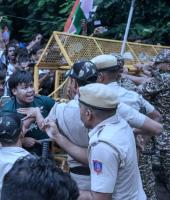
Thousands nevertheless moved forward. Some reports placed the participation in the tens of thousands. They encountered layers of barricades and a large deployment of police and paramilitary personnel. International news agencies and photographic reports documented the use of batons and tear gas against demonstrators. Smaller groups continued attempting to advance even after the principal march was blocked.
There are contested accounts of how the confrontation escalated. Delhi Police alleged stone-pelting, damage to vehicles and injuries to personnel, which actually no visuals showed. At the same time, protesters, journalists and visual reports described baton charges, tear gas and injuries among students. Delhi Police denied several viral allegations—including specific claims concerning Wangchuk’s wife and the number of injured protesters—while the National Human Rights Commission reportedly sought an inquiry into a complaint that a 12-year-old girl had been hurt.
These competing claims require an independent investigation. But one fact is beyond dispute: a political demand for accountability was treated primarily as a security operation.
Only after the confrontation were two CJP representatives allowed to meet Union Minister J.P. Nadda and submit a memorandum. No binding commitment immediately emerged. The movement announced that its protest would continue, while Wangchuk said that he would continue his fast.
Dialogue came after tear gas. Representation came after barricades. The government appeared willing to receive a petition only after demonstrating that it controlled the street.
That order of events is itself a democratic warning.
Article 19 Cannot Be Reduced to Police Permission
The Constitution guarantees citizens freedom of speech and expression and the right to assemble peaceably and without arms. These rights are not absolute: the state may impose reasonable restrictions in the interests of public order, sovereignty and security. The Supreme Court has likewise recognised the constitutional right to protest while holding that public spaces may be regulated and cannot be occupied indefinitely.
But regulation is not the same as extinguishment.
A constitutional democracy must ask whether restrictions are lawful, proportionate, necessary and applied without political discrimination. “Permission” cannot become an executive veto over unpopular speech. Nor can the anticipated possibility of disorder justify treating every citizen mobilisation as a threat before it has even begun.
When the state closes transport nodes, blocks roads, deploys overwhelming force and denies protesters any meaningful route towards the institution they wish to petition, the right to assemble may survive on paper while disappearing in practice.
Sonam Wangchuk: A Fasting Citizen Under State Custody
The two movements, the Sonam Wangchuk hunger strike and the agitation over examination leaks—have now merged into a national challenge over educational integrity and the right to dissent.
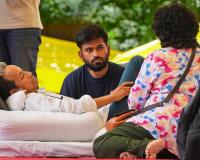
Wangchuk began fasting on June 28. On July 18, the twenty-first day of his fast, authorities removed him from Jantar Mantar and shifted him to Safdarjung Hospital after doctors warned of dangerously low potassium levels. He had opposed involuntary hospitalisation. The Delhi High Court subsequently declined immediate relief, observing that the intervention was not arbitrary given the medical risk. His wife challenged what she described as his confinement and raised objections concerning consent and access.
The state unquestionably has a duty to protect life. But it also has a duty to address why a respected educationist, innovator and environmental activist felt compelled to endanger his life before the government would speak to the movement.
Medicalising a hunger strike, that too shabbily with contempt, cannot substitute for answering its political cause. A hospital bed must not become a quieter detention site.
The Examination Republic: Years of Preparation, Minutes of Betrayal
For India’s students, an examination is rarely just an examination. It may represent years of family savings, coaching fees, migration to Kota, Delhi or Pune, parental sacrifice and the postponement of employment. When a paper leaks, an exam is cancelled or a recruitment calendar is repeatedly altered, the loss cannot be measured merely by the cost of another test.
The CJP transformed this anger into a youth-led movement using the “cockroach”—originally associated with a disparaging public reference—as a symbol of people who survive despite being ignored and demeaned. Its rise reflects a deeper collapse of confidence in the examination and recruitment machinery.
The MPSC aspirants’ struggle in Maharashtra belongs to the same crisis. Thousands have protested delays, age-limit consequences, changing examination formats and proposed computer-based testing. Following sustained opposition, Chief Minister Devendra Fadnavis advised that the move towards online examinations be deferred until 2027. Yet concerns about normalisation, transparency and the disadvantages faced by rural candidates remain unresolved.
When young citizens cannot trust either examinations or recruitment schedules, unemployment becomes more than an economic problem. It becomes a crisis of citizenship.
Ken–Betwa: Development Enforced Against the Displaced
In Bundelkhand, tribal communities and villagers opposing the Ken–Betwa river-link project have raised concerns about displacement, compensation, forest destruction and the impact on the Panna landscape. The government presents the project as a historic answer to water scarcity. Protesters ask why those sacrificing their villages, soil and community networks were not made equal partners in deciding the terms.
Recent demonstrations included symbolic “chita” and “mitti” protests. Although assistance of up to ₹12.5 lakh was announced for eligible families, protesters argued that cash could not replace land, livelihoods and social continuity. A 15-day agitation in Chhatarpur ended abruptly when police cleared the site and transported participants back to their villages.
A development project may be lawful. But when consent is absent and the principal interface with affected people is the police, legality alone cannot confer democratic legitimacy.
From Shivalik to Nakti: The Bulldozer as Governance
The Shivalik demolition conflict arose after forest and administrative authorities demolished structures in the Raika Bandi–Mahamaya belt of Jammu’s lower Shivalik region, describing them as encroachments. Reports indicated that around 30 structures were removed and nearly 60 kanals claimed as reclaimed forest land. Affected Gujjar families alleged arbitrary action and homelessness. Jammu and Kashmir Forest Minister Javed Ahmed Rana ordered an inquiry into possible excesses, while subsequent protests led to clashes and injuries.
The wider Shivalik landscape is simultaneously witnessing another resistance. In Uttarakhand, citizens have embraced trees and conducted a “Black Harela” protest against the proposed felling of more than 4,000 trees for road widening along the Bhaniyawala–Rishikesh corridor. Tree cutting continued under heavy police deployment, and protesters were detained near an ecologically important elephant corridor.
In Nakti-Sammanpur near Raipur, more than 85 homes were reportedly demolished during operations on June 29 and 30. Affected residents and opposition representatives later approached the Chhattisgarh governor, seeking rehabilitation and a judicial inquiry. Some families claimed that houses built with benefits under the Pradhan Mantri Awas Yojana had also been destroyed.
The constitutional question is not whether unlawful construction can ever be removed. It is whether bulldozers are being used before transparent adjudication, meaningful notice, rehabilitation and humane alternatives. Due process conducted after demolition is not due process; it is an obituary.
Jauhar University: Law Enforcement or Political Erasure?
The Rampur Development Authority has ordered the demolition of 38 structures at Mohammad Ali Jauhar University, founded by Samajwadi Party leader Azam Khan, stating that only the medical college and academic block possessed approved plans.
The authorities describe the matter as enforcement of building regulations. Opposition parties call it political vengeance and warn that students and an educational institution are being made collateral damage in a campaign against a political opponent.
Both claims must be tested through open legal scrutiny. But the case demonstrates why demolition powers require exceptional restraint. When an institution associated with an opposition figure is threatened with near-total destruction, the state must meet a higher standard of transparency—not merely insist that its paperwork is complete.
Bidadi’s AI Dream, Farmers’ Land
Near Bengaluru, the proposed Greater Bengaluru Integrated Township—including a major AI-focused urban component—has faced prolonged opposition from farmers unwilling to surrender fertile and inherited land. The project has been promoted as a technology and infrastructure hub, but residents say it risks destroying agriculture, orchards, dairy livelihoods and village economies.
The agitation has continued for more than a year. In July, the Karnataka government announced a review committee amid growing resistance. Days later, the Karnataka High Court dismissed a PIL challenging acquisition of approximately 7,400 acres, removing a major legal obstacle even as political and farmers’ opposition persisted.
Artificial intelligence may represent the future. But a future imposed by dispossessing farmers without credible consent reproduces one of India’s oldest injustices under a fashionable technological label.
Punjab and Gujarat: Farmers Against Decisions Made Elsewhere
Punjab’s farmers have mobilised against the India–US trade framework, fearing that agricultural and dairy markets could eventually be exposed to heavily subsidised imports. Motorcycle rallies were organised across the state in July, following earlier nationwide protests. The Union government has maintained that most sensitive Indian agricultural products—including dairy, rice and wheat—remain protected. Farmers argue that negotiations affecting rural livelihoods must not proceed without direct consultation.
In Gujarat, opposition to high-tension transmission corridors has expanded from Morbi into a wider statewide movement. Farmers say towers and power lines reduce the value and productivity of agricultural land while compensation remains inadequate. The dispute is particularly revealing because renewable-energy and grid-expansion projects, though environmentally necessary, can still reproduce injustice when their costs are imposed on rural communities.
The issue is not development versus obstruction. It is development with consent versus development by coercion.
Great Nicobar: Democracy at India’s Ecological Frontier
Nowhere is this conflict more consequential than Great Nicobar.
The mega-project proposes an international container terminal, airport, township and power infrastructure at one of India’s most strategically significant and ecologically fragile locations. The government argues that the project will strengthen maritime security and trade, that only 1.82 per cent of the island’s forest cover is being diverted, that 42 environmental conditions apply and that neither the Shompen nor Nicobarese communities will be displaced.
In February 2026, the National Green Tribunal declined to interfere with the environmental clearance, citing the project’s strategic importance and prescribed safeguards. But the Calcutta High Court subsequently held maintainable PILs alleging violations of the Forest Rights Act, recognising that the case sought to protect highly vulnerable tribal communities.
This is not merely an environmental dispute. It is a test of whether isolated indigenous people, who cannot conduct media campaigns or march to Parliament, possess rights equal to those of corporations, ministries and strategic planners.
“National security” may explain why India wants infrastructure near vital sea lanes. It cannot become a phrase that ends ecological scrutiny, conceals impact assessments or presumes consent on behalf of people whose survival depends upon isolation, forest and territory.
Hasdeo and Siang: The Movements Beyond the List
Beyond the ten highlighted movements, Hasdeo Arand in Chhattisgarh remains under pressure from coal expansion. In June, the Kente Extension block received environmental clearance after in-principle forest approval involving more than 1,700 hectares, despite a Wildlife Institute of India assessment recommending that most of the Hasdeo landscape remain free from mining. Tribal organisations have continued demanding recognition of Gram Sabha authority and cancellation of new clearances.
In Arunachal Pradesh, resistance to the proposed Siang Upper Multipurpose Project has entered a volatile phase. Some villages and families have consented to pre-feasibility studies; others fear submergence, cultural destruction and militarised surveying. In June, conflict over consent led to alleged attacks on homes and prohibitory orders. A fact-finding group has alleged mass cases against villagers and the long-term deployment of security forces around project-affected areas.
These conflicts demonstrate that India’s democratic crisis is not confined to Delhi. It is unfolding wherever the state enters a community with a map, a notification and a police escort.
The Emergency Is Not Declared—Its Habits Are Arriving
India is not living under the constitutional Emergency of 1975. That distinction matters. But it would be equally irresponsible to ignore the emergence of emergency-like habits:
Permission becoming prohibition.
Preventive orders becoming routine.
Dialogue being postponed until after force.
Hunger strikes being converted into custodial medical questions.
Demolitions preceding rehabilitation.
Environmental scrutiny being weakened by strategic exceptionalism.
Protesters being discussed as security threats rather than constitutional participants.
An undeclared emergency does not arrive with a midnight proclamation. It advances gradually—through normalised barricades, selective permissions, expansive police discretion, administrative opacity and the public’s growing acceptance that dissenters deserve whatever follows.
The danger is not simply that one government may become intolerant. The greater danger is the creation of a permanent state machinery that every future government can use against its critics.
Democracy Must Win Its Own Trial
The movements of 2026 are not proof that Indian democracy has died. In fact, their courage proves that democratic consciousness remains alive. Students are still marching. Farmers are still organising. Indigenous communities are still defending forests and rivers. Courts are still being approached. Citizens are still hugging trees, carrying the national flag and invoking the Constitution.
But democracy cannot survive on the courage of protesters alone.
It requires governments willing to listen before citizens starve themselves. Police trained to facilitate peaceful assembly rather than automatically prevent it. Independent investigations whenever force is used. Transparent environmental assessments. Time-bound recruitment and examination accountability. Rehabilitation before demolition. Gram Sabha consent before the dispossession of tribal land. Parliament willing to debate the grievances gathering outside its walls.
On July 20, Parliament was physically protected from India’s students. Yet the deeper purpose of Parliament is to protect their rights.
That is the trial before the republic today. The verdict will not be delivered by a single court or election. It will be written in the manner India treats its most inconvenient citizen—the student who demands an honest examination, the farmer who refuses to sell, the tribal woman defending a forest, the family standing before a bulldozer and the peaceful marcher asking to be heard.
When a government begins to fear unarmed citizens, it is not the citizens who have become dangerous. It is democracy that has become vulnerable.
000
About The Author

Ujjwal K. Chowdhury is a senior academic, institution-builder, and political analyst based out of Kolkata, India.

Latest News


ePaper
Advertisement