New Delhi, Agency
The Congress on Tuesday intensified its attack on the Narendra Modi government over ongoing trade negotiations with the United States, alleging that New Delhi was being pressured into signing a trade agreement that would disproportionately benefit Washington while harming Indian farmers and domestic industry.
Congress general secretary in-charge communications Jairam Ramesh, in a post on social media platform X, questioned the rationale behind pursuing a trade pact with the US amid uncertainty over American tariff policies and ongoing investigations into India's trade practices.
Referring to the visit of the US Trade Representative Jamieson Greer to New Delhi, Ramesh claimed that an India-US joint statement on trade issued on February 6, 2026, had envisaged significant concessions from both sides.
According to him, the United States had agreed to reduce tariffs on Indian exports from 25 per cent to 18 per cent, while India committed to sharply lowering or eliminating tariffs on American agricultural and industrial products and increasing purchases from the US by as much as $500 billion over five years.
Ramesh alleged that the circumstances surrounding the agreement were linked to domestic political developments.
“On the request of PM Modi, while he was under pressure from Rahul Gandhi’s expose in Parliament of his cowardice in front of China, an India-US Joint statement on trade was issued on February 6, 2026,” he said.
The Congress leader argued that the trade framework lost much of its relevance after the US Supreme Court, on February 20, 2026, ruled President Donald Trump’s reciprocal tariff strategy illegal. “The very tariff concession that the US had offered India in the February 6, 2026, joint statement effectively disappeared overnight,” Ramesh claimed.
He further noted that the US subsequently imposed a temporary 10 per cent tariff on all trading partners, including India, and warned that uncertainty persists regarding Washington’s tariff regime beyond July 24, when the legal basis for the measure is set to expire.
Ramesh also pointed to an ongoing US investigation into what Washington describes as unfair trade practices by India and around 60 other countries. He alleged that the probe was being used as leverage to secure India's acceptance of the proposed trade arrangement.
“The US is clearly using this investigation as a threat to get India to formally sign the agreement as announced on February 6, 2026. Such an agreement is not a deal but a steal by the US,” he said.
Warning of potential consequences for the agricultural sector, the Congress leader claimed that farmers in states including Jammu and Kashmir, Himachal Pradesh, Bihar, Madhya Pradesh, Rajasthan and Maharashtra would be adversely affected if India opened its market to American agricultural commodities. He argued that while India was being asked to make substantial commitments, the United States was offering few binding guarantees in return.
Ramesh also expressed doubts about the reliability of any future agreement, citing what he described as US threats of higher tariffs against trading partners despite existing agreements with countries such as Japan and members of the European Union.
“There is absolutely no need for India to be bamboozled into signing any trade agreement which, as it stands now, is heavily against India's interests,” he said, urging the government to draw lessons from Malaysia, which he claimed had stepped back from its own trade negotiations with the US following the American Supreme Court verdict.
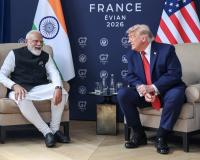
The Congress leader further accused Prime Minister Modi of seeking to appease US President Donald Trump. He also renewed the Opposition’s criticism over Trump's repeated claims regarding Operation Sindoor, saying the Prime Minister had not publicly challenged those assertions.
The remarks come amid continued negotiations between India and the United States aimed at expanding bilateral trade and resolving market access issues. Trade discussions between the two countries have focused on tariffs, agricultural imports, industrial goods and broader economic cooperation, with both sides seeking to deepen commercial ties while addressing longstanding concerns over market access and regulatory barriers.
000